
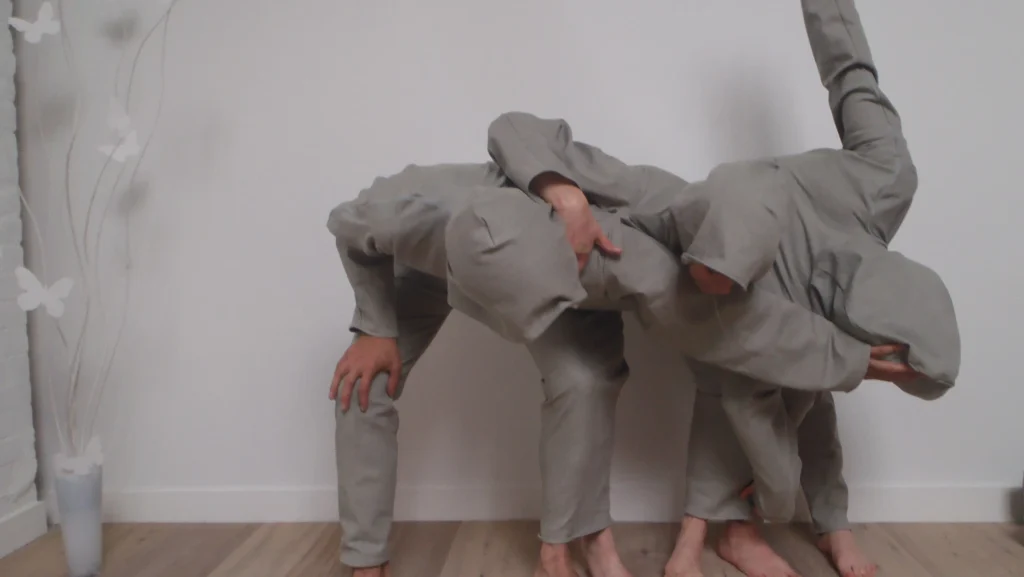
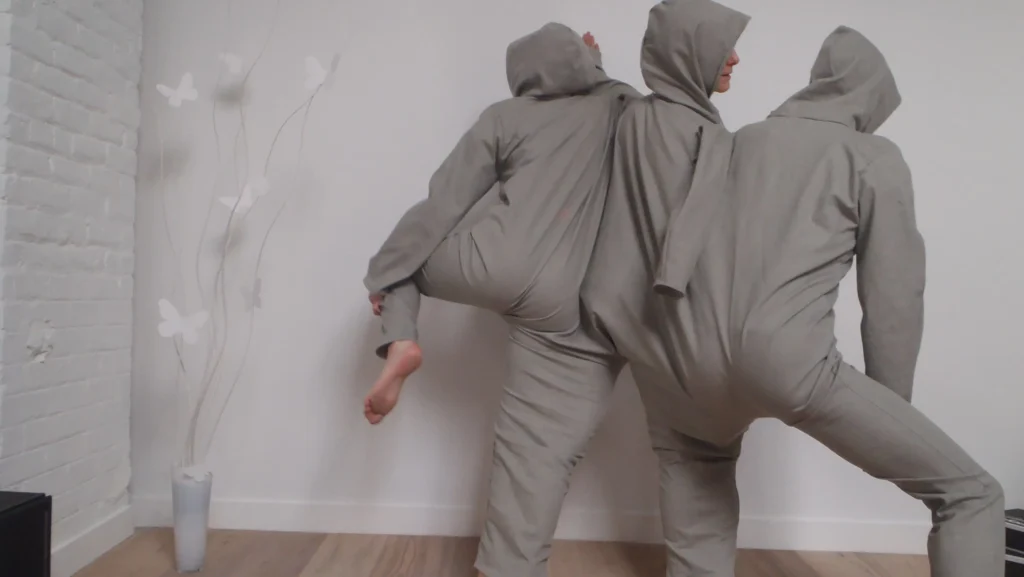
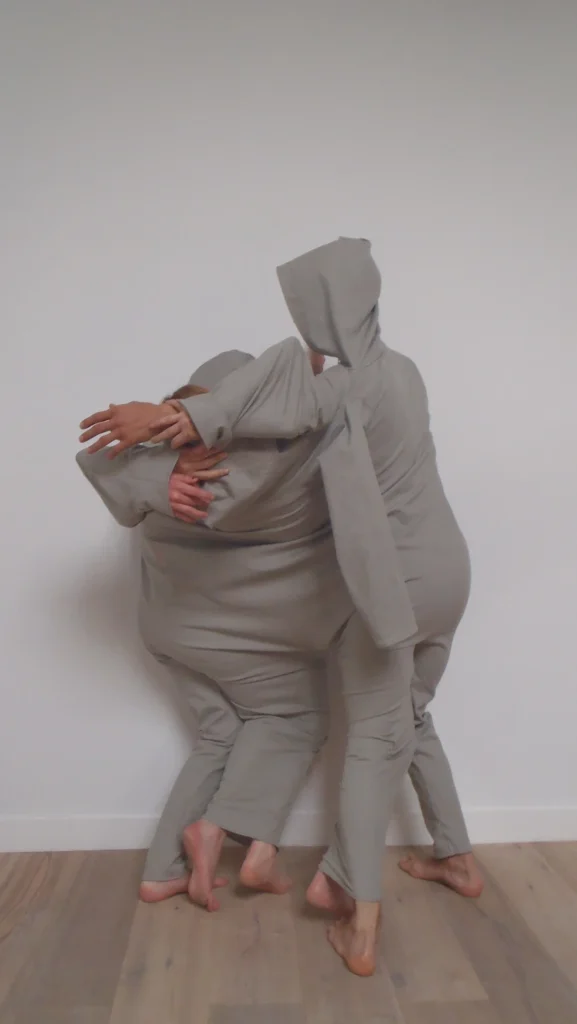
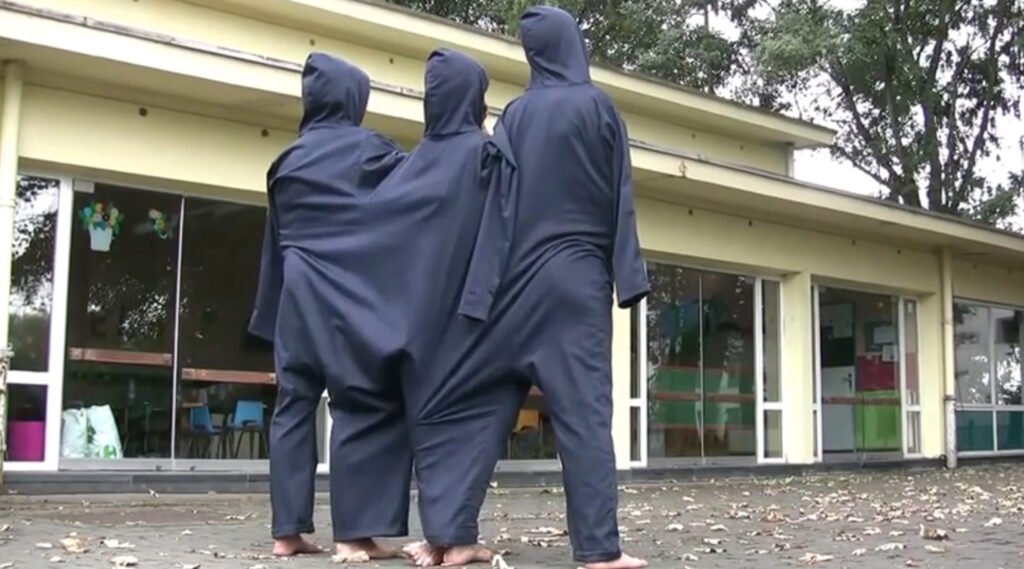
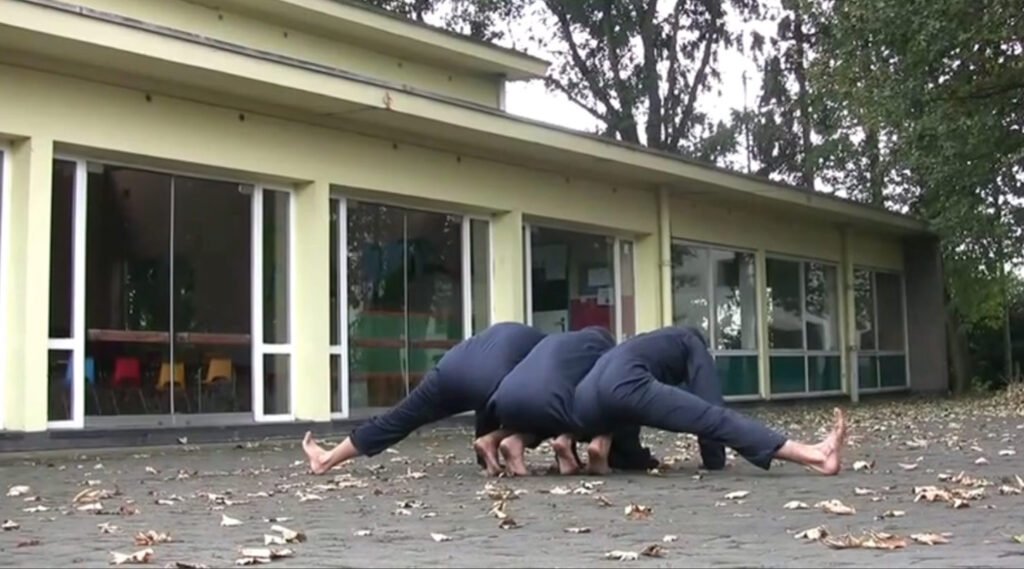
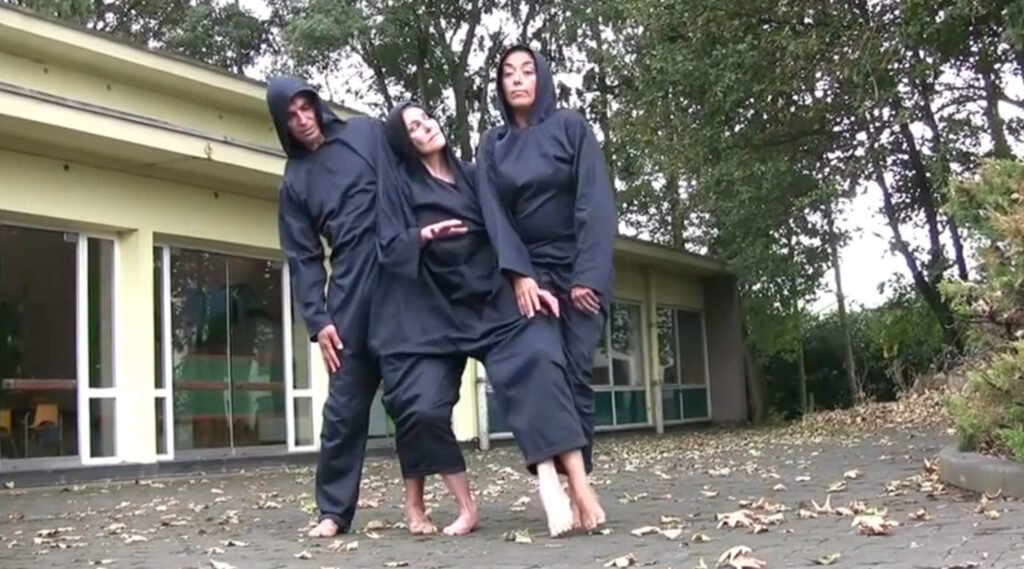
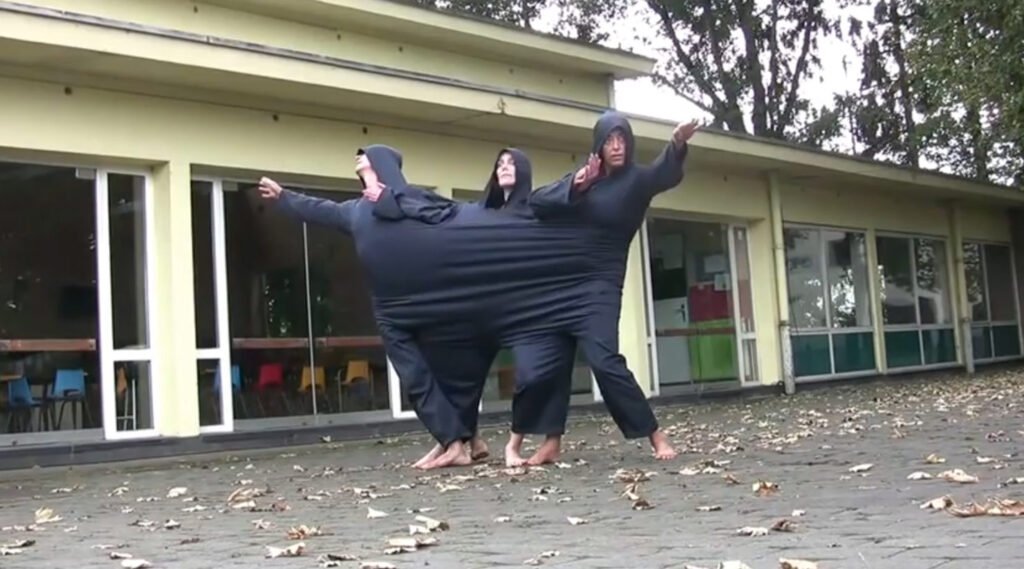
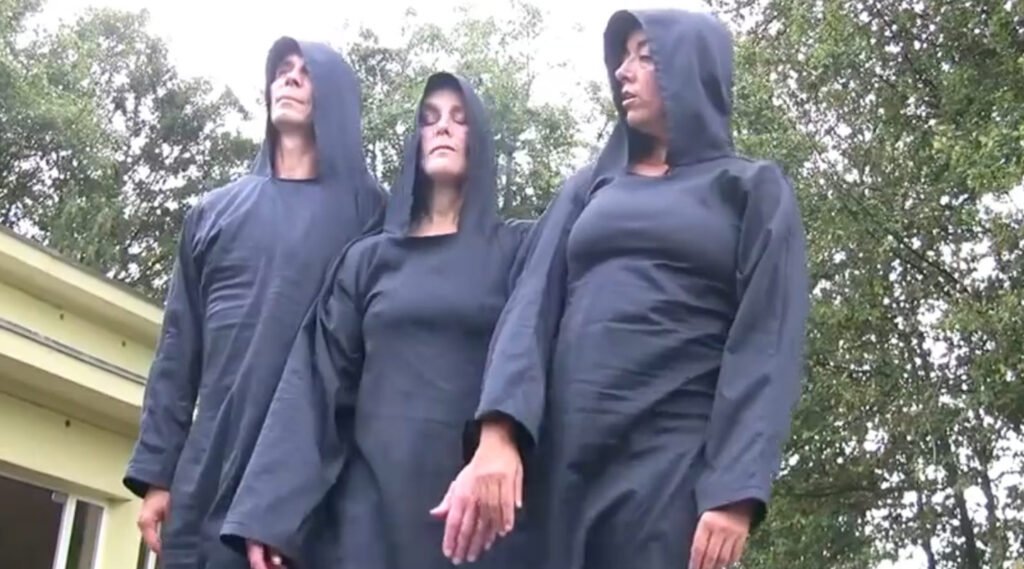
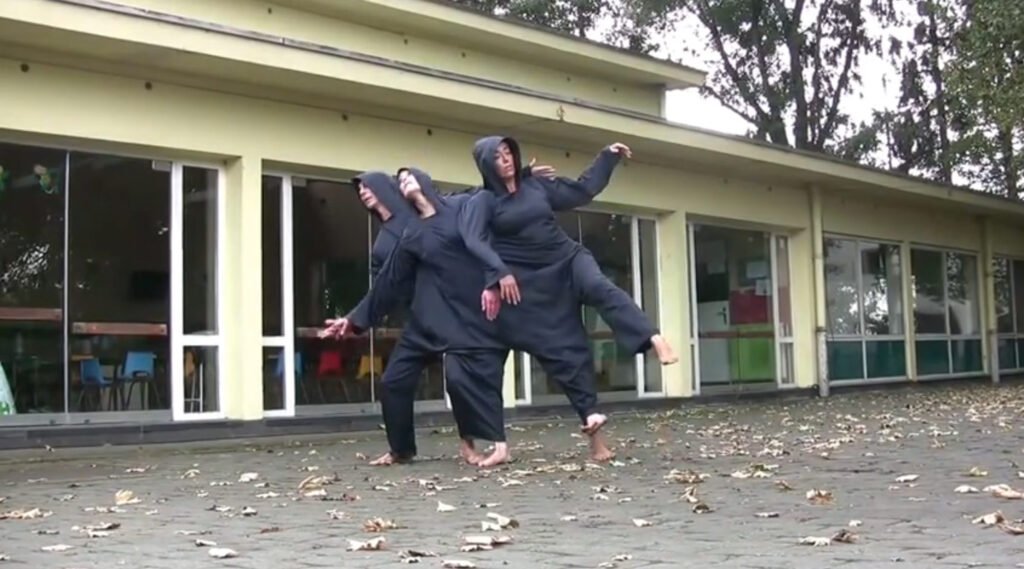
In an object commonly referred to as a “costume,” three dancers share trouser legs, sleeves, or overalls, forming a mobile three-bodied unit where every part is interdependent.
Functioning as a sort of three-person being—somewhere between acting and letting go—this performance highlights a tragicomic bond between three bodies with linked destinies. This premise, which confines the dance within a shared second skin, leads the dancers through shifting physical states. This wrapping of three people into a single, multiple entity forms the basis of a movement language spoken in unison, as they carry out shared intentions in relation to their environment.
Alternating between puppets and puppeteers, moved or moving, this extended body creates playful interactions with the chosen locations and the objects populating the urban or rural landscape.
At times a blower, at times a ringer, the musician resonates his reading of the visual with the plastic composition of the entangled bodies. His soundscape may also be in motion, encouraging the audience’s three-dimensional gaze as he moves around the three-headed sculpture—sometimes still, sometimes slowly transforming, and sometimes in a temporary state of chaos.
This wrapping of three people into a multiple entity forms the basis of the movement language they speak in unison, but it also dictates the shared intentions to be implemented in their relationship with the environment. Alternating between puppet and puppeteer, moved or moving, this extended body also allows for playful interactions to emerge within the chosen sites and among the objects inhabiting the urban or rural space.
In this incongruous task of animating a multiple body, the musician helps unify the vision by bringing the performance spaces to life through concrete sound proposals—linked to the materials of the site—resonating his reading of the image with the sculptural presence of the entangled bodies.
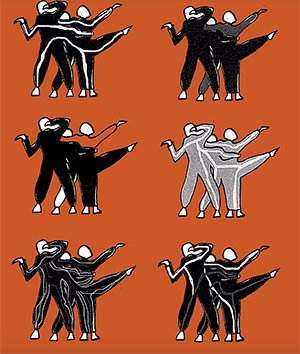
The costume, which constitutes a scenography in its own right, thus offers a strange and burlesque vision of three associated bodies. Within this three-headed body, devoid of hierarchy, the challenge lies in harmonizing the spirit animating this hybrid being, so that the relationships it creates with its surroundings are visible to everyone.
In this unusual task of animating a collective body, the musician will help unify the vision by bringing the performance spaces to life through concrete soundscapes inspired by the site’s materials, creating a resonance between his interpretation of the image and the visual composition of the intertwined bodies.
The connecting object, “the costume,” is created by Caroline Faïnke, a Belgian artist for whom textiles and their relationship to the moving body are at the heart of her artistic process.
Dance : Patricia Kuypers, Mari Siles, Franck Beaubois
Soundscape : Eric Massua
Costume : Caroline Faïnke